
The honest answer
Drying commonly takes several days and can run longer for slow materials. No honest company can promise a number before reading the moisture. The date comes from the readings, which are compared with a dry standard set from unaffected materials in your own house.
What controls the timeline
| Factor | Faster drying | Slower drying |
|---|---|---|
| Water category | Clean, fresh water | Contaminated water that needs removal first |
| Time before drying starts | Hours | Days |
| Materials | Tile, sealed floors, drywall | Hardwood, subfloor, concrete, plaster |
| Amount of water | Surface spill | Water into wall cavities and insulation |
| Equipment | Right size and placement | Too little or placed poorly |
| Weather and humidity | Mild, dry conditions | Humid conditions that slow evaporation |
Every house is different.
A typical sequence
- 1
Day 1
Stop the water, extract, remove materials that cannot dry and set equipment.
- 2
Days 2 and 3
Readings drop. Equipment is adjusted and wet pockets are chased.
- 3
Days 3 to 5
Most surfaces approach the dry standard, but slow materials lag.
- 4
Final check
Readings are recorded against the dry standard and equipment is removed.
That outline is a typical case, not a guarantee. A house with hardwood or plaster, or one where drying started a week late, runs longer. Concrete slabs can take the longest, and flooring is installed after readings are stable.
What the equipment does
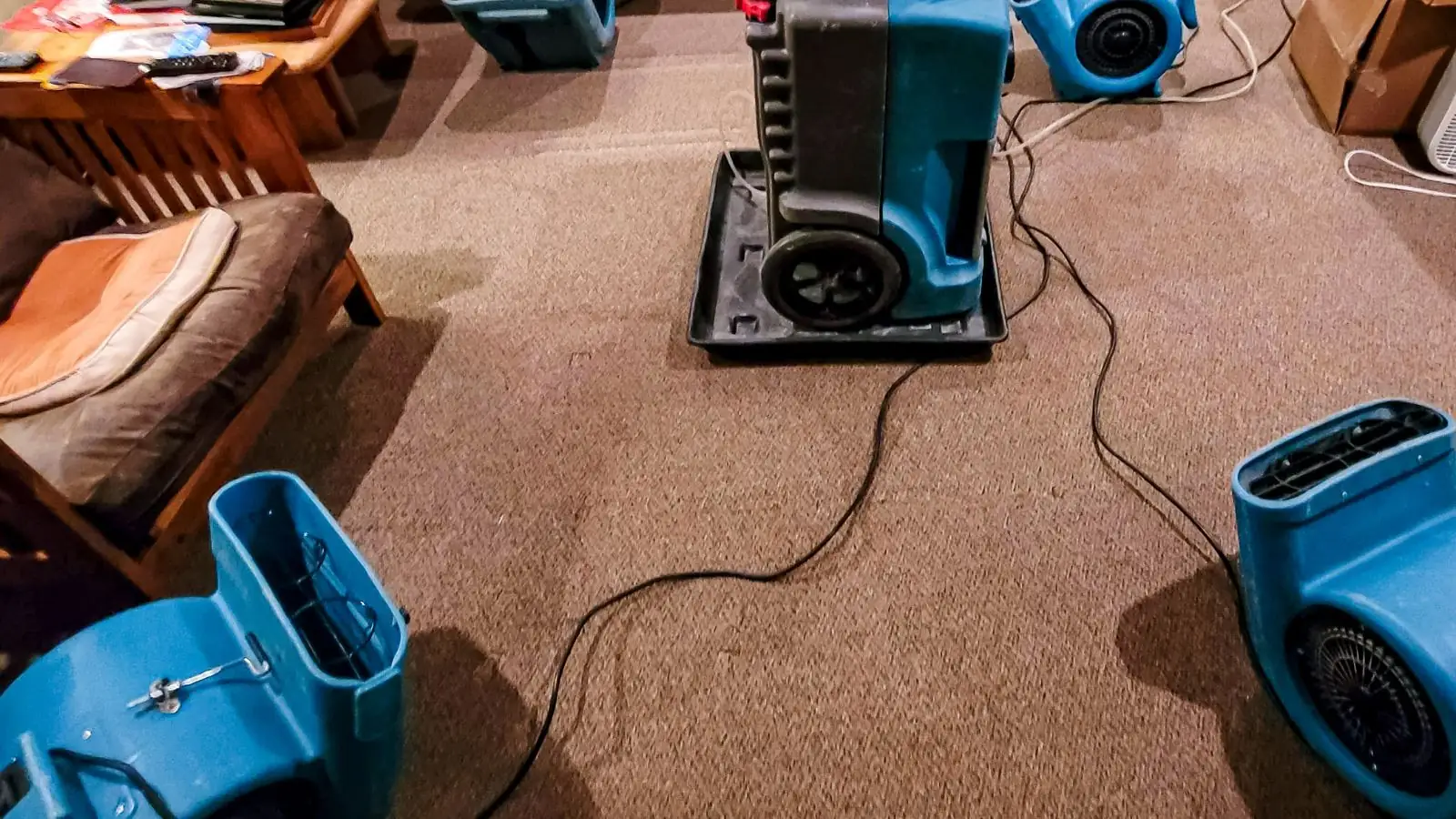
Air movers push air across wet surfaces to carry moisture off. Dehumidifiers pull that moisture from the air so it does not settle back. Moisture meters track progress, and thermal cameras find wet pockets. The water mitigation page explains each tool in more detail.
A single household fan and dehumidifier rarely dries the inside of a wall. If you are unsure, ask the crew to show you readings from the wall, not just the surface.
The 24 to 48 hour window and Colleyville weather
The EPA advises drying wet materials within 24 to 48 hours to head off mold growth, and it recommends keeping indoor humidity below 60 percent, ideally between 30 and 50 percent. Texas A&M AgriLife Extension gives a 24-hour guideline for water-soaked areas.
The City of Colleyville's Stormwater Quantity page says flash flooding generally begins at about one inch of rain per hour, and the National Weather Service reports spring and fall as the wettest periods for the Metroplex. A wet week that follows a flood slows drying, so ask the crew to track indoor humidity as well as the materials.
Signs drying is not done
- A musty smell returns after equipment is removed.
- Baseboards or drywall feel cool or damp.
- Paint bubbles or wallpaper peels.
- Wood floors keep cupping.
- Condensation appears on windows near the affected rooms.
If any of those happen, call and ask for another reading. If dark spots appear, read the mold remediation page. The water damage repair work begins only after the dry readings are in.
Homes in Keller and North Richland Hills can reach the same crews.
What a drying log shows
A drying log is the record of readings from each visit. It lists the room, the material, the moisture reading and the date, along with temperature and humidity in the room and the equipment running. You should expect to see readings fall visit by visit. If they stall, the crew changes equipment, opens another wall or adds a dehumidifier.
The log is useful beyond the drying. It is the proof that the structure reached dry standard before it was closed up, and it supports your insurance claim if the question comes up. Ask for a copy when the job ends.
How you can help at home
- Keep doors and windows closed while dehumidifiers run, so they work on the air in the room and not the outdoors.
- Do not unplug equipment, and keep cords out of wet areas.
- Remove items from the affected rooms so air can reach the walls and floors.
- Leave closet and cabinet doors open to let air in.
- Note any new smell, stain or sound and tell the crew on the next visit.
Equipment draws power, and you may see a bump in your electric bill during the drying period. Ask your insurer whether the added electricity is part of the claim, and keep your bills.
Signs drying is not finished
- A musty smell that returns when the equipment is turned off
- Baseboards or trim that still feel cool or damp to the touch
- Paint that bubbles or drywall seams that open up
- Floors that keep cupping after the crew leaves
- A hygrometer reading that stays above 60 percent in the room
Any one of these is a reason to call the crew back before walls are closed or flooring goes down. Drying is cheaper to extend than to redo.
A warmer room dries faster, but heat alone does not remove moisture from the air. Dehumidifiers and air movers do that.
Air movers and dehumidifiers run all day to dry the structure. The noise is the work. A crew can explain which units can pause at night.
After readings show the structure is dry. Moving it earlier can block airflow and trap moisture.
Yes, when indoor humidity rises. A crew uses dehumidifiers to hold the air dry and tracks humidity as well as the materials.