
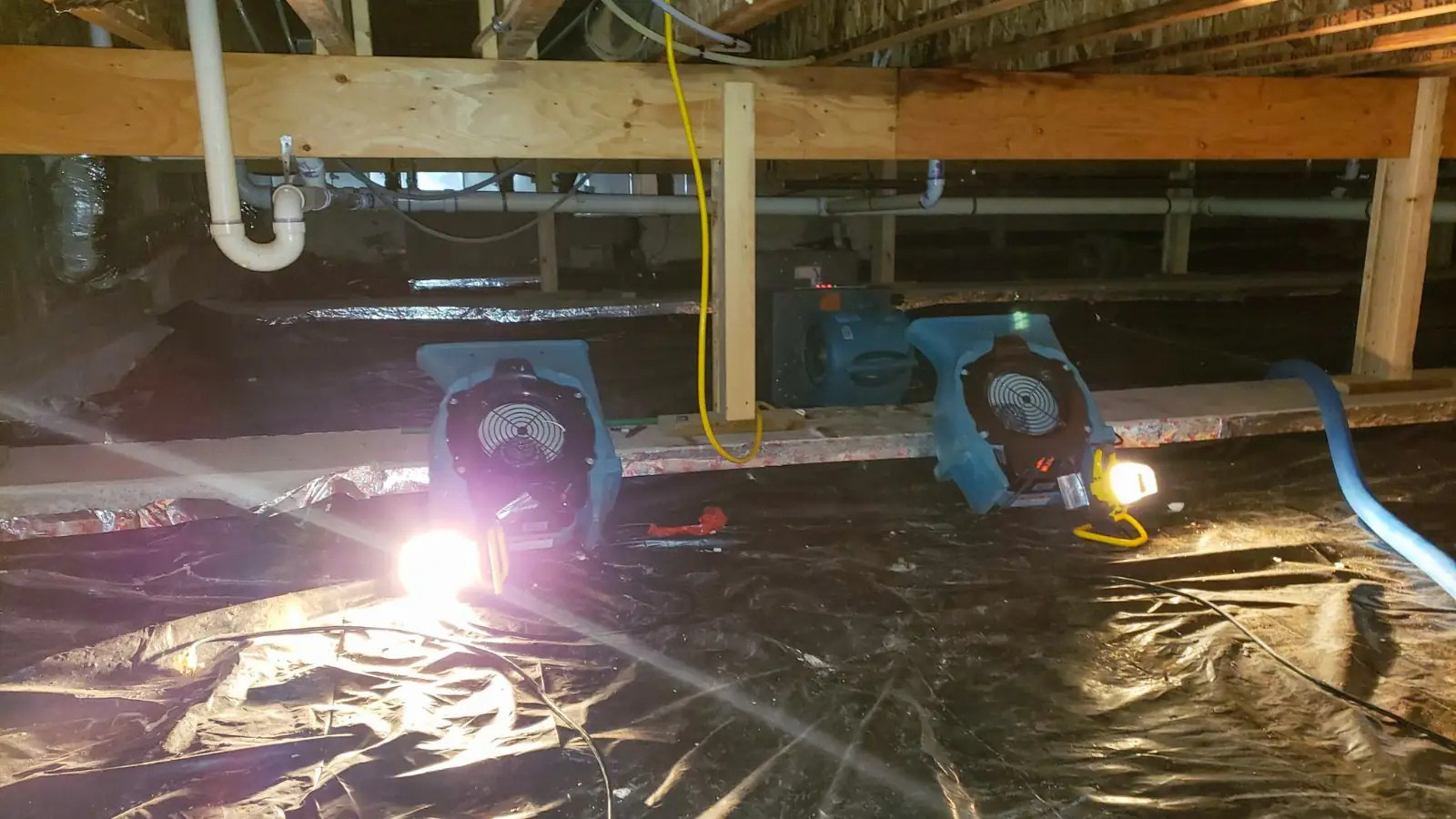
Start with the moisture, not the mold
Mold grows where moisture lingers, and lower levels and crawl spaces hold moisture because they sit close to the ground. The usual sources are plumbing leaks above, water through foundation walls, poor drainage outside and humid air condensing on cool surfaces. If you remove the mold and leave the moisture, it will return.
Not every Colleyville home has a basement, and this guide applies equally to a crawl space, a lower-level room or any damp lower area. What matters is the moisture, which you can find by looking for stains, damp insulation, standing water, plumbing drips and downspouts that dump water near the foundation.
What to do before anyone cleans
- Find and stop the water. A plumbing leak needs a plumber. Water entering from outside needs a drainage fix.
- Photograph the affected areas and note when water last entered.
- Do not scrub, sand, bleach or run a fan across visible mold, because that can spread particles.
- Dry what you can. Run a dehumidifier if the area is enclosed and safe to be in.
- Decide whether you want testing first. Under Texas rules, testing and removal are separate jobs.
How big is the problem
| What you see | What it often means |
|---|---|
| A few small spots on a hard surface | Surface growth, often fixable once the moisture is solved |
| Growth on drywall or insulation | Material is wet inside. Removal is likely |
| Musty smell with no visible mold | Hidden moisture, often behind walls or under floors |
| Standing water or damp soil in a crawl space | Active source that needs drainage or plumbing work first |
| A large area or several rooms | Containment and a written protocol are the safer approach |
An assessment gives you the actual picture.
How Texas separates testing from removal
The Texas Department of Licensing and Regulation licenses people and companies that assess and remediate mold. Its FAQ says a licensee may not do both the assessment and the remediation on the same project, and that clearance requires a post-remediation assessment.
Exemptions depend on the property type, and houses are treated differently from large rental buildings, so ask any company what license it holds and whether your job falls under the state rules.
What remediation looks like in a lower level
A crew seals off the area with plastic, runs air filtration and removes affected materials such as drywall, insulation and carpet. Hard surfaces and framing are HEPA vacuumed and cleaned. The standard that describes this work is ANSI/IICRC S520, and you can ask whether the crews follow it.
In a crawl space, the work also includes looking at vapor barriers, insulation, ventilation and drainage, because those are often the reason moisture collected. The mold remediation page lists questions to ask any contractor.
Restoration is not waterproofing
If water enters through a foundation wall or because the yard slopes toward the house, restoration will dry and rebuild but will not stop the next rain. A drainage or foundation specialist is the right trade for that problem, and we say so plainly. The flood damage restoration page explains what is and is not covered.
Neighbors in Keller and Euless can reach the same line for an assessment plan.
A crawl space checklist
- Look for standing water or damp soil after rain.
- Check that the vapor barrier, if present, is intact and covers the ground.
- Look at the underside of the floor for dark staining or sagging insulation.
- Check plumbing for drips at joints and shutoffs.
- Make sure downspouts and grading send water away from the foundation.
- Note any musty smell that rises into the house from vents or floor registers.
Wear protective gear in a crawl space, bring a light and tell someone where you are. If you see wiring close to water, stay out. Crawl spaces are tight, and a restoration or inspection crew has the tools and training to work in them safely.
Keeping moisture from coming back
After cleanup and drying, the long-term work is moisture control. That can mean extending downspouts, regrading soil, fixing a leaking pipe, adding a vapor barrier or running a dehumidifier. The EPA recommends keeping indoor humidity below 60 percent and ideally between 30 and 50 percent, and a cheap hygrometer in the lower level tells you whether you are meeting that.
Recheck the space after the next heavy rain. A dry crawl space on a sunny week is not the same as a dry crawl space in a downpour.
Dehumidifiers and ventilation
A properly sized dehumidifier with a drain line works better than one you empty by hand, because a full tank shuts the unit off. Place it away from walls so air can move, and check the humidity reading weekly. Closing foundation vents or sealing a crawl space changes airflow, so ask a professional before doing either.
Small surface spots on hard materials are sometimes cleaned by homeowners, but mold in drywall, insulation or a large area is a larger job. Fix the moisture first and call before you disturb it.
Bleach can discolor the surface, but it does not remove growth inside porous materials and it does not fix moisture. Removal and drying do.
Not always, but testing and a written protocol give you a record, and they allow independent clearance afterward. Texas rules keep the assessor and remediator separate on a project.
The Texas Department of Licensing and Regulation. Verify a company's license on the TDLR site before you sign.