
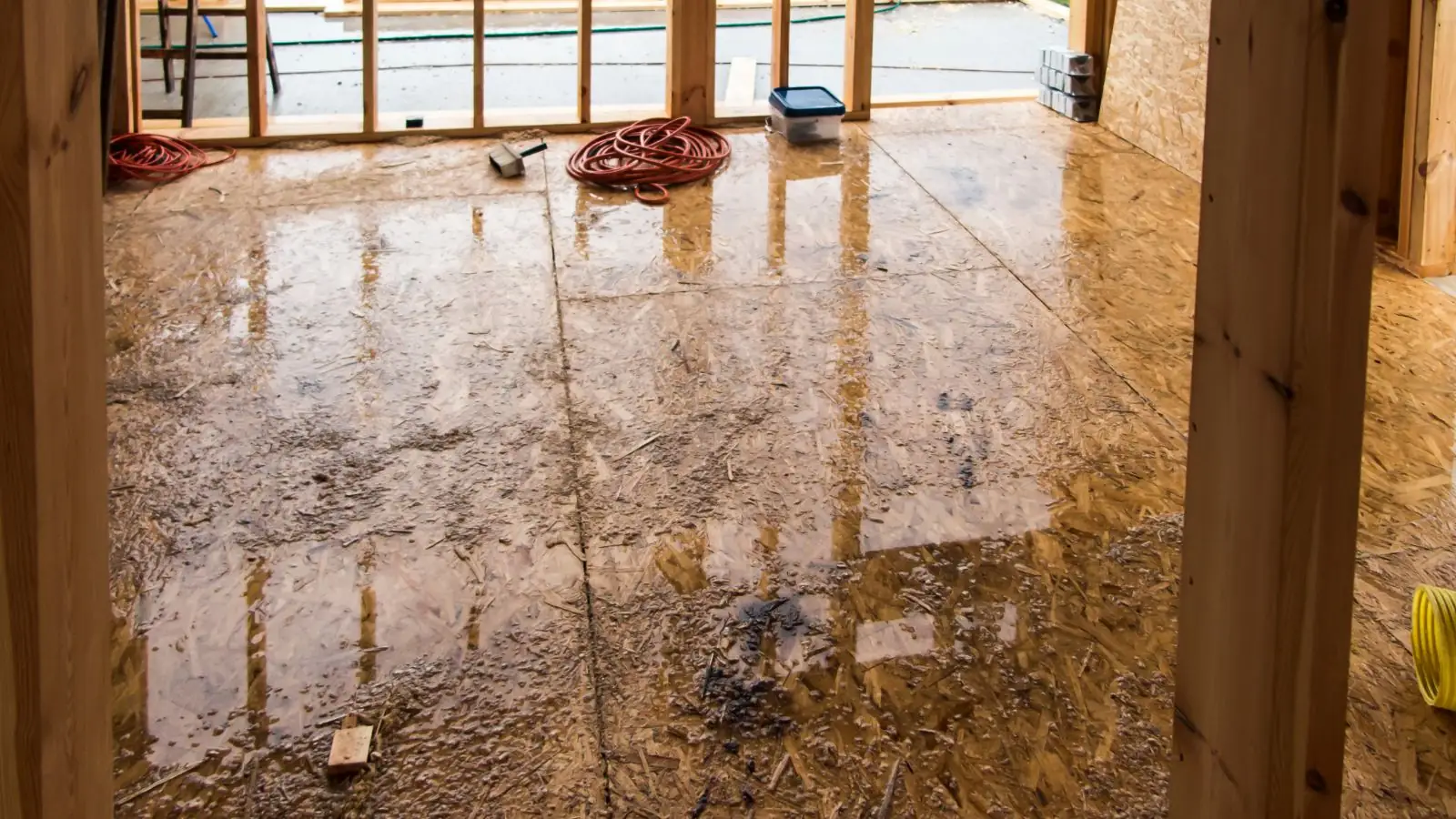
What water does to a wood floor
Wood absorbs water through its edges and its underside, and it swells as it takes in moisture. If the bottom of a board gets wetter than the top, the edges rise and the board cups. If the whole floor swells beyond the room to expand, the boards push up from the subfloor and buckle. Finish does not stop this, because water slips in through seams and from below.
| Stage | What you see | What it means |
|---|---|---|
| Early swelling | Boards feel slightly raised, seams tight | Often recoverable with fast drying |
| Cupping | Edges higher than the center | May flatten as the floor dries, sanding may follow |
| Crowning | Center higher than the edges | Often shows after a cupped floor is sanded too early |
| Buckling | Boards lift off the subfloor | Usually replacement |
| Dark staining | Gray or black patches | Mold or long-term moisture, often replacement |
A moisture reading over several days is what decides it.
Why you should not sand right away
A cupped floor can look ready for sanding a few days after the leak, but the moisture is still working its way out. If you sand a floor that is still wet, you flatten it at the wrong moisture level, and when it finishes drying the edges drop and the center rises. That is crowning, and it is harder to fix than the cupping was.
A crew takes readings of the boards and the subfloor each visit and waits until they stabilize. Only then does sanding and refinishing make sense.
Drying a wood floor
Drying a wood floor usually combines extraction of any standing water, removal of wet baseboard so air can reach the edges and dehumidification to pull moisture from the boards. Some crews use drying mats that pull moisture through the surface under negative pressure. These can help on smaller areas, but they do not rescue every floor.
If the subfloor is wet, drying can take longer than the surface suggests. The water mitigation page explains the equipment and the logs a crew keeps.
Save, refinish or replace
- Save and refinish when cupping is mild, the water was clean and the floor dried quickly.
- Replace affected boards when a limited area buckled or stained and the rest is sound.
- Replace the floor when most of it is buckled, moldy or the subfloor is damaged.
- Tear out first when the water was gray or black, because contaminated wood is not cleaned in place.
Matching is often the hard part. Old boards have aged and darkened, new boards do not match unless the whole room is refinished. Many repairs ask you to refinish edge to edge so the color is even. The water damage repair page covers rebuilding in more detail.
Moisture, insurance and finishes in Colleyville
Texas A&M AgriLife Extension advises keeping indoor relative humidity between 30 and 50 percent, and the EPA gives the same ideal range with a ceiling of 60 percent. A humidity gauge in a room with a hardwood floor is a cheap way to know whether the air is helping or hurting the boards.
The Texas Department of Insurance says most policies cover sudden and accidental water damage, such as a burst pipe or a broken washer hose, while gradual leaks are usually excluded. A floor that cups slowly because of a hidden leak is a different insurance question than one flooded by a supply line, so tell your adjuster the timeline.
What to do right now
- Stop the water and remove standing water.
- Take photos of the floor and the source.
- Lift rugs and furniture and keep the floor clear.
- Run fans and a dehumidifier if the water was clean and small. Call a crew if more than a small area is wet.
- Do not seal the floor with wax, poly or covering until readings are dry.
Homes in Southlake and Grapevine are served by the same line.
Solid, engineered and laminate floors behave differently
| Floor type | Reaction to water | Recovery outlook |
|---|---|---|
| Solid hardwood | Swells, cups, buckles when soaked | Often recoverable if dried fast, can be sanded after it stabilizes |
| Engineered wood | Layers can separate, edges swell | Thinner wear layer, so less refinishing is possible |
| Laminate | Core swells and does not return | Usually replaced when wet |
| Vinyl plank | Water may seep under, trapping moisture | Often lifted to dry the subfloor, then replaced |
Product details vary, so confirm with the manufacturer.
Engineered wood has a thin top layer of real wood over a plywood core, and that layer limits how many times it can be sanded. A cupped engineered board may flatten after drying but not have enough wear layer left for a full refinish.
Furniture, rugs and cleaning
Lift wet rugs and furniture off the floor as soon as you can do so safely, because dye and metal feet leave stains on wet wood. Do not drag heavy furniture across a swollen floor, since the surface is soft and gouges easily. Wipe standing water and let air move across the boards, but do not use heat guns or space heaters aimed at the floor, which can crack the finish and dry the surface faster than the core.
Do not apply wax, polish or a new coat of finish until the readings are stable. Sealing a wet floor locks moisture in.
Sometimes, if the water was clean and drying began quickly. Many floors flatten partway and need sanding after readings stabilize.
Until the boards and subfloor reach a stable, dry reading. That is often weeks, not days, for a floor that took on a lot of water.
Only briefly. Water enters through seams and from below, so a finish buys a few minutes, not hours.
It can be when a sudden and accidental event caused it, according to the Texas Department of Insurance. Gradual leaks are usually excluded. Your policy decides.